Wedding Budget Breakdown by Percentage (With $10K, $20K and $30K Examples)
By Altar & Agenda · Updated
Once you've agreed on a total wedding budget, the next question is how to split it. Percentages are the easiest way to start, because they work at any budget: a split that makes sense for $30,000 also gives you a sensible first draft for $12,000.
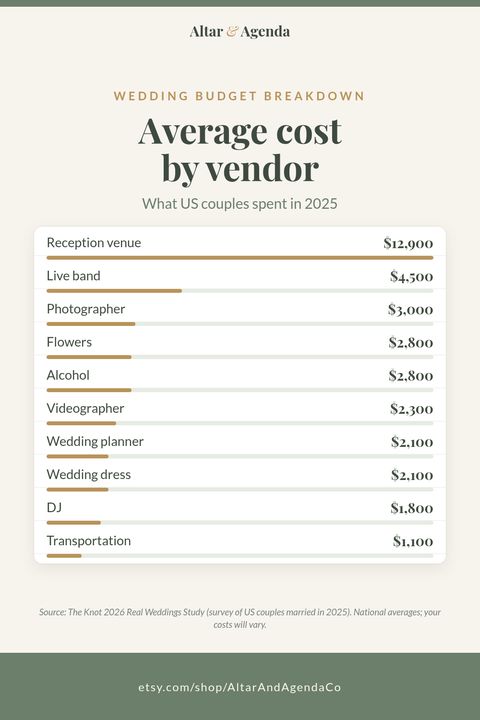
Below is a category-by-category wedding budget breakdown by percentage, the reasoning behind each number, dollar examples for $10,000, $20,000 and $30,000 budgets, and how to adjust the split for your priorities. If you'd rather skip the arithmetic, plug your own numbers into our free wedding budget calculator.
On this page
The starting split
There's no official formula, and no couple spends exactly like this. But this split is a realistic first draft for a traditional ceremony and reception with a meal, and it lines up with what US couples actually spend on average (more on that below).
| Category | % of budget | What it covers |
|---|---|---|
| Venue and rentals | 27% | Ceremony and reception venue, tables, chairs, linens, tent, lighting rentals |
| Catering, bar and cake | 22% | Food, drinks, service staff, cake or dessert |
| Photography and video | 11% | Photographer, videographer, album |
| Flowers and décor | 8% | Bouquets, centerpieces, ceremony décor, candles, signage |
| Attire and beauty | 7% | Dress or suit, alterations, accessories, hair and makeup |
| Music and entertainment | 6% | DJ or band, ceremony musicians, sound |
| Planner or coordinator | 4% | Full planner, partial planning or day-of coordination |
| Rings, officiant and license | 3% | Wedding bands, officiant fee, marriage license |
| Stationery and postage | 2% | Save-the-dates, invitations, day-of paper, stamps |
| Transportation | 2% | Couple's car, guest shuttle |
| Favors and gifts | 2% | Guest favors, wedding party and parent gifts |
| Buffer | 6% | Overages, tips, service charges, things you forgot |
| Total | 100% |
Why venue and catering get about half
Venue and catering together take roughly half of most wedding budgets, because they're the two categories that scale with your guest count. The Knot 2026 Real Weddings Study (US couples married in 2025) put the average reception venue at $12,900 and catering at $80 per person. With the study's average of 117 guests, that's about $9,400 of catering, so the two together come to roughly $22,300, or about 65% of the $34,200 average wedding. Many couples who hire an all-inclusive venue pay less for catering separately, which is why our split lands nearer 49%: it assumes you'll shop around and use the buffer for overages.
Why there's a buffer line
The buffer is the most important row in the table. Tips, service charges, sales tax, alterations and postage regularly add hundreds or thousands of dollars that weren't in the original quotes. The Knot's own advice is to reserve at least 5% as a "just in case" fund. We use 6%, and 8 to 10% is safer if you're planning on a short timeline.
Dollar examples: $10K, $20K and $30K wedding budget breakdowns
Here's the same split applied to three common budgets. Use these as a sanity check, not a rule: a $10,000 wedding rarely looks like a scaled-down $30,000 one (see the adjustments below).
| Category | % | $10,000 | $20,000 | $30,000 |
|---|---|---|---|---|
| Venue and rentals | 27% | $2,700 | $5,400 | $8,100 |
| Catering, bar and cake | 22% | $2,200 | $4,400 | $6,600 |
| Photography and video | 11% | $1,100 | $2,200 | $3,300 |
| Flowers and décor | 8% | $800 | $1,600 | $2,400 |
| Attire and beauty | 7% | $700 | $1,400 | $2,100 |
| Music and entertainment | 6% | $600 | $1,200 | $1,800 |
| Planner or coordinator | 4% | $400 | $800 | $1,200 |
| Rings, officiant and license | 3% | $300 | $600 | $900 |
| Stationery and postage | 2% | $200 | $400 | $600 |
| Transportation | 2% | $200 | $400 | $600 |
| Favors and gifts | 2% | $200 | $400 | $600 |
| Buffer | 6% | $600 | $1,200 | $1,800 |
What a $10,000 wedding budget looks like in practice
At $10,000, the percentages above only work with a smaller guest list. $4,900 for venue and catering combined covers roughly 50 to 60 guests at a casual venue with a buffet or food truck, not 120 at a ballroom. The Knot's data shows the effect clearly: weddings with 1 to 50 guests averaged $17,100, while weddings with more than 100 guests averaged $43,300.
Couples at this budget often move money around: a park, restaurant or family property instead of a traditional venue, a friend as officiant, a DJ instead of a band, and grocery-store or DIY flowers. The Knot reports that couples spending under $12,000 most often chose non-traditional venues like parks or a family home, relied on DIY décor and asked friends to officiate.
What a $20,000 wedding budget looks like
$20,000 sits a little below the national median of $24,000 reported in the same study, so it's a very normal wedding budget. At this level, a photographer around the national average ($3,000) is realistic, though it's more than the 11% shown. Many couples at $20,000 decide whether video is a must: skipping it frees up about $2,300 (the national average videographer cost) for food, flowers or guests.
What a $30,000 wedding budget looks like
At $30,000 you're close to the national average. You can usually afford a full-service venue, a photographer and videographer, a DJ, a planner or day-of coordinator, and a meaningful buffer. The decisions here are about priorities rather than survival: band versus DJ, flowers versus photo album, a bigger guest list versus a nicer meal.
How to adjust the split for your priorities
Percentages are a first draft. The point is to change them on purpose, not by accident. A simple method:
- Each of you picks your top three priorities separately, then compare. Overlaps get more money.
- Pick one or two "minimum viable" categories you're happy to keep simple (favors and transportation are common choices).
- Move money in whole percentage points. If photography goes from 11% to 15%, find 4 points elsewhere, such as flowers (8% to 6%) and favors (2% to 0%).
- Keep the total at 100%. Your spreadsheet (or our calculator) should show the total so you notice when it drifts.
Some common adjustments:
| If your priority is... | Consider |
|---|---|
| Photos and video | Photography 15%, flowers 6%, favors 0%, transportation 1% |
| Food and drink | Catering 28%, venue 24%, décor 6% |
| A big party | Music 9%, venue 26%, attire 6% |
| A small or micro wedding | Venue 15%, catering 20%, photography 18%, attire 10%, a bigger buffer |
| A destination wedding | Add a travel and lodging row (often 10 to 15% for the couple's own costs) and trim décor |
Fixed costs vs. per-guest costs
The most useful thing a percentage split can't show you is how much your guest count drives the total. Some costs are fixed: your photographer and DJ usually charge the same for 60 guests or 160. Others scale with every guest: catering, bar, cake, rentals, stationery and favors.
The Knot found couples spent an average of $292 per guest in 2025. But removing ten guests doesn't save $2,920, because the fixed costs don't move. A better estimate is:
Savings = guests removed × (your per-guest costs ÷ your guest count)
So if your per-guest categories add up to $11,000 for 110 guests, each guest really costs about $100 in variable spending, and trimming ten guests saves about $1,000. Our guide to how many guests to invite shows how to estimate your real headcount before you commit to a venue.
Turn your percentages into a working budget
A percentage split is only the first tab of a good wedding budget. Once you've chosen your numbers:
- Put your total in one cell and make every category's budget a formula (
=Total × %), so everything updates when your total changes. - Add a "Quoted" and a "Spent" column next to each budget line, and a "Left" column that subtracts them.
- Track payments separately, one row per deposit or balance, with due dates. Most budgets fail on timing, not totals.
Our step-by-step wedding budget spreadsheet guide walks through building all of this in Excel or Google Sheets, including the formulas.
Frequently asked questions
What percentage of a wedding budget should go to the venue?
Plan on about 25 to 30% for the venue and rentals, or around 45 to 50% if your venue includes catering. Combined, venue and food are roughly half of most budgets, because both scale with your guest count.
What percentage of the wedding budget is photography?
About 10 to 12% is a common starting point. Couples who rank photos as their top priority often go to 15% or more, especially at smaller budgets, where a photographer's fee is a bigger share of the total.
How much should I set aside as a wedding budget buffer?
At least 5%, and 8 to 10% if you're planning in under a year or have lots of vendors. The buffer covers tips, service charges, taxes and the small costs that rarely appear in quotes.
Is the 50/30/20 rule used for weddings?
Not really. 50/30/20 is a personal-budgeting rule for income (needs, wants and savings). For a wedding, a category split like the table above is more useful, because it maps directly onto vendor quotes.
How do I split a wedding budget between families?
There's no fixed rule today. Most couples agree a total first, then ask each contributor what they'd like to give, and track contributions in their budget so everyone can see where the money goes. Write down any expectations attached to a contribution (such as extra guests) before you plan around it.
Want it done for you?
Try the numbers in our free wedding budget calculator: enter your total and guest count, adjust any percentage and see the dollar amount for every category. When you're ready to track real quotes and payments, our Wedding Budget Tracker for Excel and Google Sheets has the categories, payment schedule and cost-per-guest what-if tab ready to go. It's also part of the Complete Wedding Planner and the Wedding Planner Bundle.
Just starting out? Download our free 12-month wedding planning checklist (one page, no sign-up).
Sources
- The Knot, The Average Wedding Cost, According to The Knot Data (2026 Real Weddings Study, 10,474 US couples married in 2025): average cost, cost per guest, guest-count brackets, vendor averages and the 5% buffer advice.
- The Knot, 2026 Real Weddings Study data read-out: median cost and spending brackets.
Disclosure: Altar & Agenda makes the templates linked above. The percentage split is our suggested starting point, not an industry standard; cost figures are US national averages and your costs will vary.
Free: one-page 12-month wedding checklist
60 tasks from "set your budget" to thank-you notes. PDF, no sign-up.
Get the free checklistBrowse our planners on Etsy