Wedding Day Timeline: Sample Schedules for 2pm, 4pm and 5pm Ceremonies
By Altar & Agenda · Updated
A good wedding day timeline is invisible. Guests just notice that dinner arrived on time, the speeches didn't drag and the sun was golden during your portraits. Behind that is a schedule built backwards from a few fixed points, with buffers everywhere.
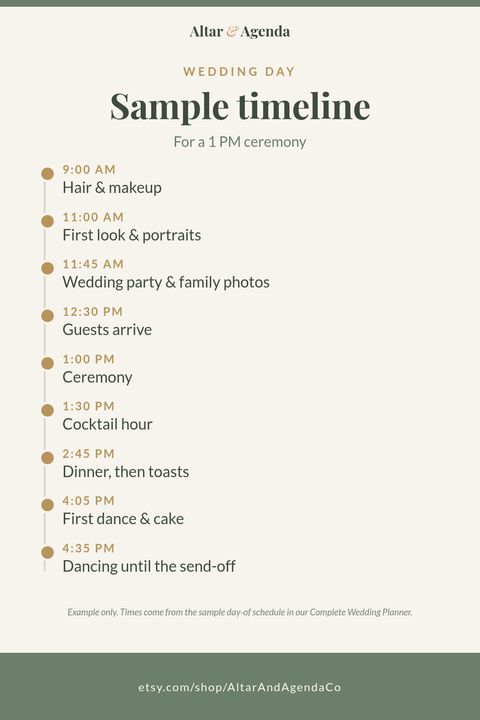
This guide shows how long each part of a wedding day typically takes, then gives sample timelines for 2pm, 4pm and 5pm ceremonies that you can adapt. Share your final version with every vendor and your day-of point person at least two weeks before the wedding.
On this page
- How long each part of the day takes
- Step 1: Find your fixed points
- Step 2: Decide on a first look
- Sample timeline: 4pm ceremony with a first look
- Sample timeline: 2pm ceremony (with a lunch or early dinner reception)
- Sample timeline: 5pm ceremony without a first look
- Step 3: Add buffers (more than you think)
- Step 4: Write separate versions for vendors
- Frequently asked questions
- Want it organized for you?
How long each part of the day takes
These are typical durations for a traditional ceremony and reception. Use them as building blocks.
| Part of the day | Typical time | Notes |
|---|---|---|
| Hair and makeup | 45 to 90 minutes per person | A 4pm ceremony with five or six people often starts around 8:30am |
| Photographer arrives (details, getting ready) | 2 to 4 hours before the ceremony | Detail shots, getting-ready candids |
| First look and couple portraits | About 30 minutes | Unhurried, before the ceremony |
| Wedding party and family photos | 30 to 60 minutes | Faster with a written shot list |
| Couple and wedding party hidden before ceremony | 30 minutes | Guests arrive about 30 minutes early |
| Ceremony | 20 to 30 minutes | Religious ceremonies can run longer |
| Cocktail hour | 60 minutes (up to 90 without a first look) | Covers post-ceremony photos |
| Reception | About 4 hours | Entrance, first dance, dinner, toasts, cake, dancing |
The Knot's guidance is that a typical reception lasts about five hours including cocktail hour, and most ceremonies last around 30 minutes.
Step 1: Find your fixed points
Before you write a single time, list the things you can't move:
- Ceremony start time (on the invitations).
- Venue access and end time. When can vendors load in, and when does music have to stop?
- Sunset time for your date and location, if you want golden-hour portraits. Search "sunset [city] [date]".
- Hair and makeup headcount. More people means an earlier start.
- Photographer and videographer coverage hours. Know when they start and stop.
Step 2: Decide on a first look
A first look (seeing each other privately before the ceremony) is the biggest decision affecting your timeline:
- With a first look: couple portraits, wedding party photos and most family photos happen before the ceremony. You can usually join part of your cocktail hour.
- Without a first look: all of those photos move to after the ceremony, which usually means missing most of cocktail hour. Planners often extend cocktail hour to 75 to 90 minutes or push the schedule back 30 to 45 minutes.
Neither is right or wrong. It's a trade-off between a traditional aisle moment and a calmer evening.
Sample timeline: 4pm ceremony with a first look
This is adapted from a planner-backed schedule published by The Knot, and it's the most popular shape for a Saturday wedding.
| Time | What's happening |
|---|---|
| 8:30am | Hair and makeup begins (five to six people) |
| 12:00pm | Photographer arrives: details, getting-ready candids |
| 12:30pm | Hair and makeup wraps; getting-ready photos and individual portraits |
| 1:15pm | Getting dressed |
| 2:00pm | First look and couple portraits (30 minutes) |
| 2:30pm | Wedding party and family photos |
| 3:30pm | Final touches; couple and wedding party out of sight as guests arrive |
| 4:00pm | Ceremony |
| 4:30pm | Cocktail hour begins; a few post-ceremony photos |
| 5:00pm | Couple joins cocktail hour |
| 5:30pm | Reception doors open, grand entrance, first dance |
| 6:30pm | Dinner |
| 7:30pm | Toasts and speeches |
| 8:00pm | Dancing |
| 9:00pm | Cake cutting and dessert |
| 9:30pm | More dancing |
| 10:30pm | Last dance and send-off |
Without a first look: move the couple portraits and wedding party photos to 4:30 to 5:30pm (you'll miss most of cocktail hour), and push the reception entrance back 15 to 20 minutes.
Sample timeline: 2pm ceremony (with a lunch or early dinner reception)
An earlier ceremony suits daytime receptions, winter weddings with early sunsets, and venues with earlier curfews.
| Time | What's happening |
|---|---|
| 7:00am | Hair and makeup begins |
| 10:00am | Photographer arrives |
| 11:00am | Getting dressed |
| 11:45am | First look and couple portraits |
| 12:15pm | Wedding party and family photos |
| 1:30pm | Guests arrive; couple out of sight |
| 2:00pm | Ceremony |
| 2:30pm | Cocktail hour |
| 3:30pm | Entrance and first dance |
| 4:00pm | Lunch or early dinner |
| 5:00pm | Toasts |
| 5:30pm | Cake cutting, then dancing |
| 8:00pm | Send-off |
A 2pm start makes for a shorter, more relaxed day, and many venues price daytime events lower. The trade-off is harsh midday light for photos in summer, so a shaded portrait spot helps.
Sample timeline: 5pm ceremony without a first look
A later ceremony gives you a relaxed morning and lets portraits fall closer to golden hour in summer.
| Time | What's happening |
|---|---|
| 10:00am | Hair and makeup begins |
| 1:30pm | Photographer arrives |
| 3:00pm | Getting dressed; individual portraits |
| 3:45pm | Separate photos with each side of the wedding party |
| 4:30pm | Couple out of sight; guests arrive |
| 5:00pm | Ceremony |
| 5:30pm | Family photos (immediate family first, then extended), then couple and wedding party portraits |
| 5:30 to 7:00pm | Extended cocktail hour (90 minutes) |
| 7:00pm | Grand entrance and first dance |
| 7:15pm | Dinner |
| 8:15pm | Toasts |
| 8:45pm | Dancing |
| 9:30pm | Cake cutting |
| 11:00pm | Last dance and send-off |
In summer, plan a 15-minute golden-hour portrait break during dinner or dancing if sunset falls in the evening.
Step 3: Add buffers (more than you think)
Every wedding runs a little late somewhere. Add:
- 15 minutes between hair and makeup finishing and getting dressed.
- 10 to 15 minutes for every move between locations, plus parking and walking time.
- 5 minutes per family photo grouping. A 12-grouping family photo list takes about an hour; a short, written list with names is the fastest way to get through it.
- A hard stop for speeches. Ask each speaker to keep it to around three to five minutes.
Step 4: Write separate versions for vendors
One master timeline is enough for you. Your vendors each need the parts relevant to them:
- Photographer and videographer: every location, the family photo list and any must-have moments.
- Caterer: guest arrival, dinner service time, cake cutting and vendor meals.
- DJ or band: the order of events, all song choices and the names of everyone giving a speech.
- Day-of point person: everything, plus phone numbers for every vendor.
Frequently asked questions
How long is a typical wedding day?
For the couple, often 12 hours or more from hair and makeup to send-off. For guests, about five and a half to six hours: a 30-minute ceremony, an hour of cocktails and around four hours of reception.
How long should a wedding reception be?
About four hours after cocktail hour is typical. Shorter receptions (three hours) work well for daytime or smaller weddings.
When should the photographer arrive?
Usually two to four hours before the ceremony, depending on whether you're doing a first look, getting-ready photos and detail shots.
What time do wedding guests arrive?
About 30 minutes before the start time on the invitation, so plan to have the couple and wedding party out of sight by then.
When should we cut the cake?
Often after dinner and toasts, partway through dancing. It gives guests a natural break and signals dessert. If older guests may leave early, cut it sooner.
Want it organized for you?
Our Complete Wedding Planner spreadsheet includes a day-of schedule tab alongside the budget, guest list, RSVPs, seating chart and an auto-dated checklist, so the timeline lives in the same file as everything else. Still early in planning? Grab the free 12-month wedding planning checklist.
Sources
- The Knot, Sample Wedding Timeline for a 4 p.m. Ceremony: the 4pm schedule, first-look timing and adjustments without a first look.
- The Knot, The Complete Wedding Reception Timeline and Cocktail Hour guide: reception length and cocktail hour timing.
Disclosure: Altar & Agenda makes the template linked above. The 2pm and 5pm schedules are our own samples; always confirm timings with your venue and vendors.
Free: one-page 12-month wedding checklist
60 tasks from "set your budget" to thank-you notes. PDF, no sign-up.
Get the free checklistBrowse our planners on Etsy